


Marvel Cinematic Universe timeline
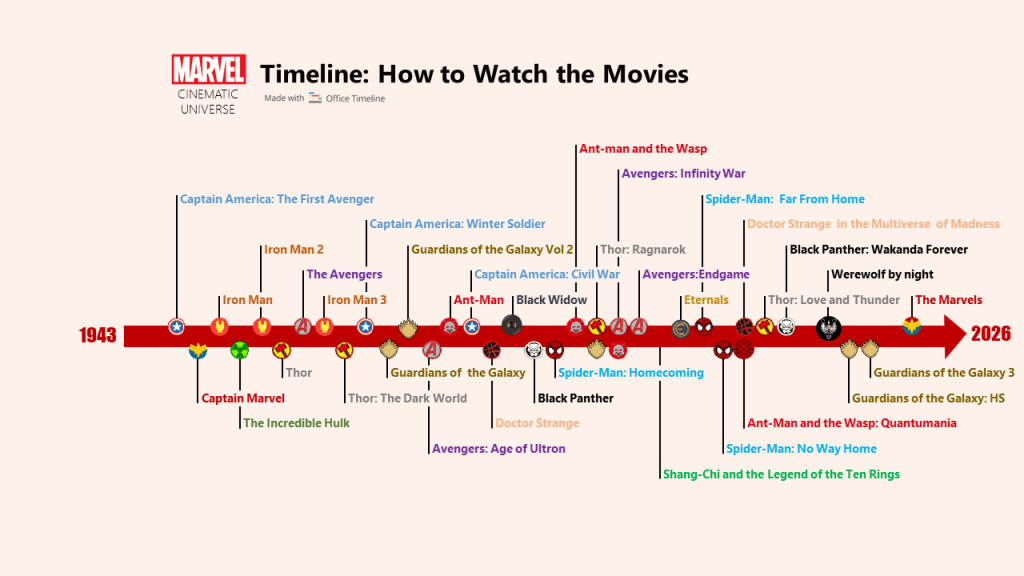
The Marvel Cinematic Universe timeline illustrates the recommended viewing order of major MCU movies and TV series.

Last updated on February 6, 2024
Having a tough time figuring out how to watch the Marvel movies in order? Don’t worry, you aren’t the only one! The Marvel Cinematic Universe (MCU) is an incredibly complex and interwoven set of superhero stories peppered with time travel and retconning. As of such, both diehard fans and those who’ve recently acquired a taste for the genre can sometimes get confused about the sequence of events.
Nevertheless, an overview of the MCU timeline is essential for understanding how each story fits in the bigger picture, as well as the intricate connections between them. To lend a helping hand, we’ve harnessed the neutron star-like powers of Office Timeline and brought into existence an easy-to-read map of the Marvel movies in chronological order – and of the TV series as well. Enjoy!
How to watch the Marvel movies in chronological order
With all the time-travel and flashbacks, watching the Marvel movies in order can become tricky even for diehard fans of the franchise. To lend a helping hand and address the abounding disagreements, we’ve run a proverbial red thread through the narratives and created the MCU timeline of big screen productions.
If you’re just looking to watch the movies in chronological order, here’s how you can do it:
- Captain America: The First Avenger
- Iron Man
- The Incredible Hulk
- Iron Man 2
- Thor
- The Avengers
- Iron Man 3
- Thor: The Dark World
- Captain America: The Winter Soldier
- Guardians of the Galaxy
- Guardians of the Galaxy Vol 2
- Avengers: Age of Ultron
- Ant-Man
- Captain America: Civil War
- Doctor Strange
- Black Widow
- Black Panther
- Spider-Man: Homecoming
- Ant-Man and the Wasp
- Captain Marvel
- Thor: Ragnarok
- Avengers: Infinity War
- Avengers: Endgame
- Shang-Chi and the Legend of the Ten Rings
- Eternals
- Spider-Man: Far from Home
- Spider-Man: No Way Home
- Doctor Strange in the Multiverse of Madness
- Thor: Love and Thunder
- Werewolf by Night
- Guardians of the Galaxy Holiday Special
- Guardians of the Galaxy 3
- Ant-Man and the Wasp: Quantumania
- The Marvels
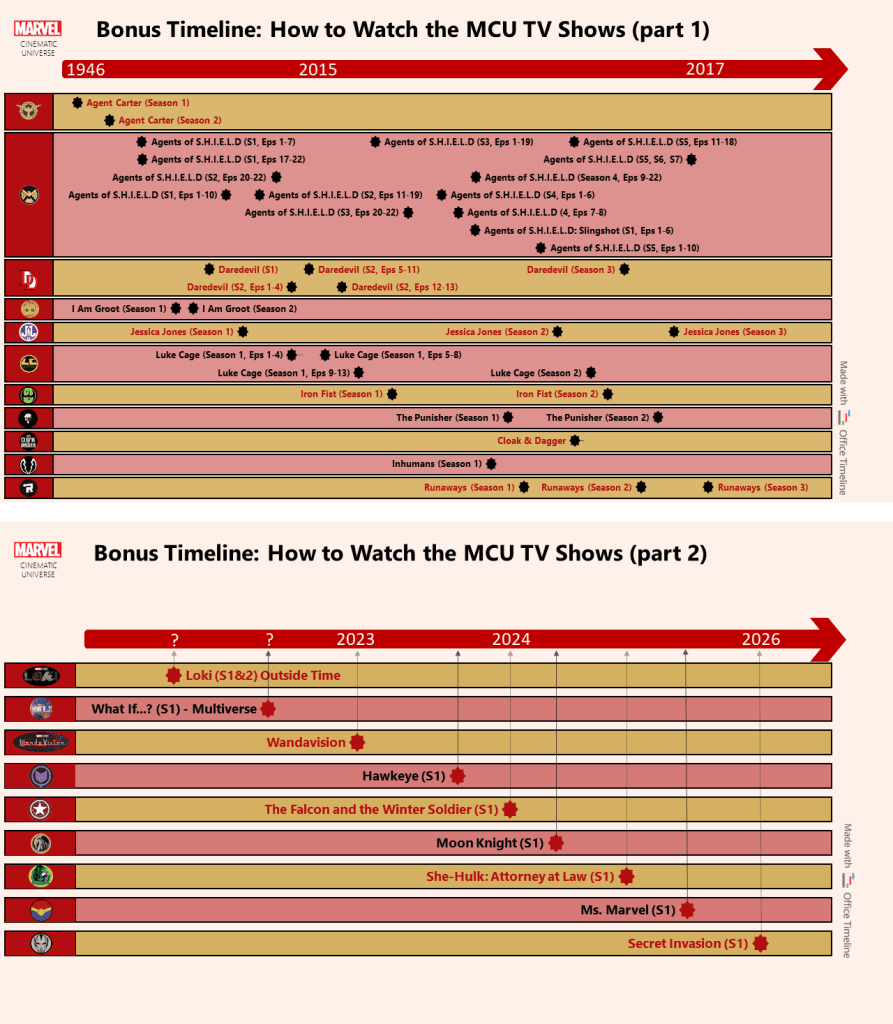
Bonus: How to watch the Marvel TV series in order
The TV series are, with some exceptions, relatively coherent with the Marvel timeline, but showrunners are trying to break free from constraints of the movie narrative and grow their stories independently. Our goal is to touch on the major, canon releases without delving outside of the established franchise.
FAQs about the Marvel Cinematic Universe
Let’s explore some of the most frequently asked questions related to the Marvel Cinematic Universe (MCU)
How we built the MCU timeline
The Marvel Cinematic Universe Timeline was made with the help of Office Timeline, a professional project management solution that allows you to create visually appealing timelines, Gantt charts and roadmaps in a matter of minutes.
You can download the Marvel Cinematic Universe timeline as a PowerPoint file and either move the shapes by hand or use the Office Timeline free 14-day trial to update the timeline automatically.
Frequently asked questions
There are two ways to sort the MCU timeline: based on the historical progression of the events in the stories and based on the movie/series release dates. We firmly believe it’s easier to go for the event chronology, especially for those who are relatively new to Marvel’s ever-expanding universe. However, movie buffs might also find it enjoyable to trace the cinematic evolution of superhero stories based on the release dates.
If you try to watch the Marvel movies in the order of their release dates, you’re going to have a bad time. For instance, the first movie released within this MCU franchise is Iron Man, which takes place in 2010, but the events are predated by Captain America: The First Avenger set during World War II and Ms. Marvel in 1995. To put it simply, there is no real connection between the production release dates and the narrative.
Therefore, yes, viewing the Marvel movies in chronological order renders the storyline substantially more coherent and comprehensible.
- Captain America: The First Avenger
- Iron Man
- The Incredible Hulk
- Iron Man 2
- Thor
- The Avengers
- Iron Man 3
- Thor: The Dark World
- Captain America: The Winter Soldier
- Guardians of the Galaxy
- Guardians of the Galaxy Vol 2
- Avengers: Age of Ultron
- Ant-Man
- Captain America: Civil War
- Doctor Strange
- Black Widow
- Black Panther
- Spider-Man: Homecoming
- Ant-Man and the Wasp
- Captain Marvel
- Thor: Ragnarok
- Avengers: Infinity War
- Avengers: Endgame
- Shang-Chi and the Legend of the Ten Rings
- Eternals
- Spider-Man: Far From Home
- Spider-Man: No Way Home
- Doctor Strange in the Multiverse of Madness
- Thor: Love and Thunder
- Werewolf by Night
- Guardians of the Galaxy Holiday Special
- Guardians of the Galaxy 3
- Ant-Man and the Wasp: Quantumania
- The Marvels
We recommend starting with the very first Captain America movie, aptly named “The First Avenger”, for a couple of reasons. It might be the 5th film in the MCU to be released, but the story arc takes place during the second World War, predating the next film in the franchise by more than half a century. It also introduced the iconic bad guys of the shadowy organization named Hydra, Captain America’s comic book arch nemesis Red Skull and the Tesseract. These are just a few things that will make the MCU timeline much easier to follow later on.
The events in the first two seasons of “Agent Carter” are chronologically set right after Captain America: The First Avenger. This makes them the best choice for anyone who wants to view the Marvel movies in order alongside the television series.
The MCU stands for Marvel Cinematic Universe and it’s a franchise spanning multiple movies, TV series and short films featuring superheroes from the comic books released by Marvel Comics. These story arcs are interlinked and the universe in which they exist is shared, so do expect many of the movies and series to include crossovers of plot elements, characters, settings, etc.
In addition to that, Marvel has also released tie-in comics and a series of short films called “Marvel One-shots”. The MCU timeline is split into phases, based on the release dates of the productions and currently we are in Phase 4, which debuted with the 2021 series WandaVision.
There is some debate around this question, primarily because the television series Agents of Shield seems to have severed ties with the canon titles by becoming a parallel multiverse to the wider MCU timeline. More exactly, in season 7 of the show, the S.H.I.E.L.D. team travels to 1931 and back to 2019 (which is why we didn’t include it on the timeline).
However, as far as canon titles go, the Marvel timeline starts in 1943 with the tale of Steve Rogers aka Captain America. Still, it’s best to keep in mind that when time travel is on the table, nothing is set in stone. Not to mention that a certain version of a certain mischievous Norse god is somehow still out there. Sort of.
The movies in the Marvel Cinematic Universe are split into 6 phases (so far) in accordance with their release dates:
- The Infinity Saga: Phase One (2008-2012): Iron Man, The Incredible Hulk, Iron Man 2, Thor, Captain America: The First Avenger, Marvel’s The First Avengers.
- Phase Two (2013-2015): Iron Man 3, Thor: The Dark World, Captain America: The Winter Soldier, Guardians of the Galaxy, Avengers: Age of Ultron, Ant-Man
- Phase Three (2016-2019): Captain America: Civil War, Doctor Strange, Guardians of the Galaxy Vol. 2, Spider-Man: Homecoming, Thor: Ragnarok; Black Panther; Avengers: Infinity War; Ant-Man and the Wasp; Captain Marvel; Avengers: Endgame; Spider-Man: Far From Home.
- The Multiverse Saga: Phase Four (2021-2022): Black Widow; Shang-Chi and the Legend of the Ten Rings; Eternals; Spider-Man: No Way Home; Doctor Strange in the Multiverse of Madness; Thor: Love and Thunder; Black Panther: Wakanda Forever
- Phase Five (2023-2024): Ant-Man and the Wasp: Quantumania; Guardians of the Galaxy Vol. 3; The Marvels ; Captain America: New World Order; Thunderbolts.
- Phase Six (2025-2027): Blade; Deadpool 3; Fantastic Four; Avengers: The Kang Dynasty; Avengers: Secret Wars.
This classification does not account for the chronological order of the MCU, but it can help you keep track of new release dates.
Virtually all films and series give viewers some information about the MCU, characters, plotlines, etc. That being said, given the extent of this cinematic universe and the sheer number of writers coming up with new narratives, certain pieces have less impact than others. If you feel overwhelmed by the amount of screen time you’d need to invest, here are a few productions you could dispense with:
- The Incredible Hulk (characters that show up in the film are later overhauled, very little important information is carried over to later films);
- Iron Man 3 (self-contained narrative);
- Spider-Man: Homecoming (little connection to the MCU overarching story);
- Guardians of the Galaxy Vol. 2 (little connection to the MCU overarching story);
- Black Widow (chronologically set after Captain America: Civil War, when audiences have already learned Natasha’s fate);
- Hawkeye (although it debuts Echo, there’s little else tying the show to the MCU);
- Moon Knight (well-received by audiences and critics, the series is quite disconnected from the rest of the Marvel Cinematic Universe);
- She-Hulk: Attorney at Law (fun to watch and does expand on characters like Wong or Daredevil, but has no bearing on the MCU main narrative);
- Guardians of the Galaxy: Holiday Special (it’s just a holiday special);
- Inhumans (not the best Marvel and it has already been cancelled);
- Iron Fist (no relation to the rest of the MCU so far);
- Agent Carter (features Captain America’s one and only sweetheart Peggy Carter, but its ties to the MCU are frail);
- Eternals (no real connection to the rest of the MCU other than passing mentions of events);
- Werewolf by Night (pretty cool horror show, but doesn’t tie into the MCU);
- Secret Invasion (self-contained story arc);
- What If…? (storylines are purely speculative and not considered canon).
Eddy is Co-Founder & Chief Product Officer for Lucen Timeline (formerly Office Timeline), building a user-friendly but powerful app that makes timelines, Gantt charts and roadmaps directly in PowerPoint.

Subscribe to our blog
Get all the tips, tricks and inspiration you need to create professional looking timelines, straight to your inbox.