


Sales plan template
A sales plan template for PowerPoint showing a full-year Gantt-style layout with four color-coded swimlane rows, task bars with date ranges, and quarterly major milestones on a single presentation slide.
Powered by Lucen Timeline (formerly Office Timeline)

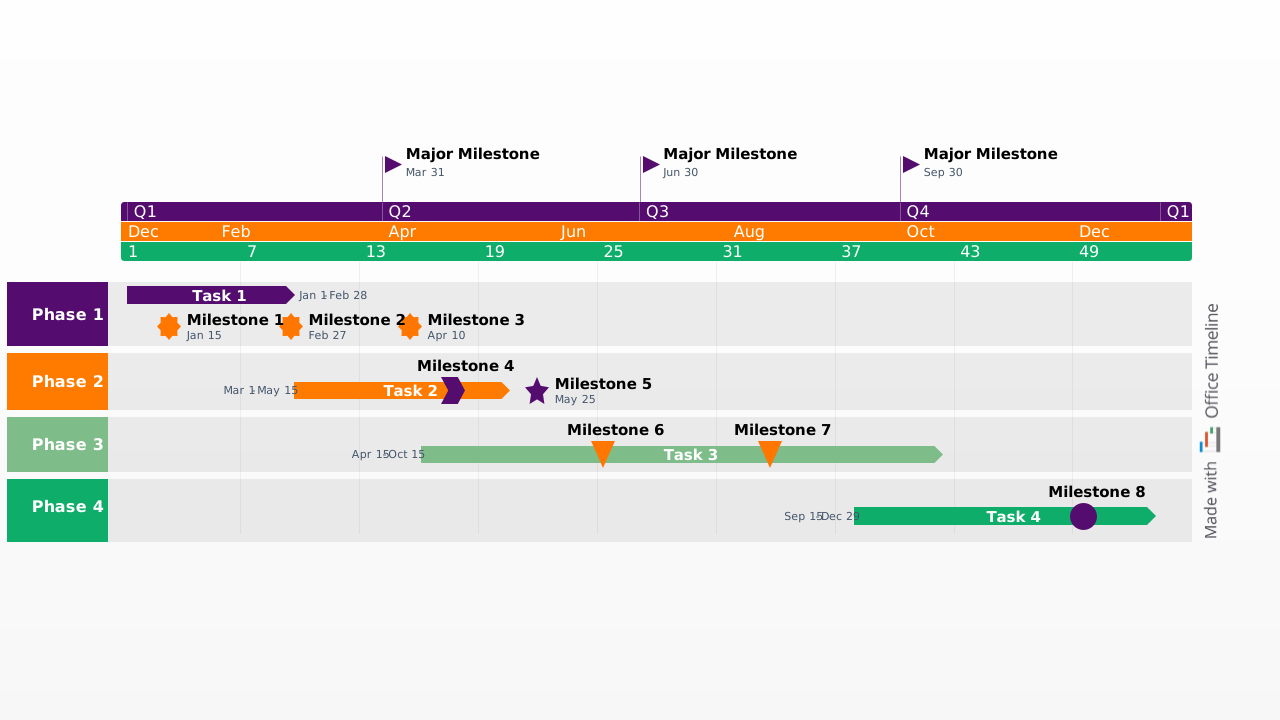
A clear, well-structured sales plan is essential in today's competitive business environment. Designed to lay out a company's overall strategy for improving sales results over a defined timeframe, a sales plan helps sales leaders and entrepreneurs to:
- define sales targets and revenue goals for their business;
- choose the approach best suited to their target market;
- identify the most effective tactics for their sales team;
- outline roles and responsibilities across the team and senior management;
- establish the budget and steps needed to hit set targets;
- monitor progress and adjust tactics as the plan evolves;
On this page you will find a free downloadable sales plan template alongside key facts about effective sales planning to help you get started.
Using the sales plan template
This free sales plan template was built for sales leaders, marketers and account executives who need to present their business plans to staff, sales teams and management. It can be customized to show campaign plans over days, weeks, months, quarters, or years, and presents them in a format that is easy for any audience to follow.
The template can be used as a visual aid to align teams around key targets and deadlines, or as a scorecard to track a plan's progress against its objectives. Because it is built natively in PowerPoint, it is easy to share, edit and re-share with anyone on your team.
You can edit the template directly in PowerPoint by adding your own data to the slide's placeholders and adjusting milestones and tasks manually. For faster editing, you can use the Lucen Timeline add-in for PowerPoint, which updates the template automatically from inside PowerPoint and revises your slide instantly whenever the plan changes. With the free 14-day trial, you can also import data directly from tools like Microsoft Excel to build your sales plan in seconds.
Frequently asked questions
A well-structured sales plan requires careful preparation. Here are the key steps:
- Define your objective - determine the core purpose of your sales efforts, whether that is closing specific deals, entering a new market, or growing an existing account.
- Assess your current situation - evaluate where your business stands today in relation to that goal, including a SWOT analysis of your strengths, weaknesses, opportunities and threats.
- Identify barriers and risks - list the obstacles that could slow your progress so you can plan around them.
- Develop your sales call strategy - use data from previous years to identify trends, build a sales forecast and outline how you will reach your targets.
- Define your resource needs - determine what budget, tools and team capacity you will need to execute your strategy.
- Build a concrete action plan - create a clear timeline of tactical, actionable steps with assigned owners and deadlines.
You can learn how to make a timeline to support your sales plan using tools like PowerPoint or Excel with our step-by-step tutorials.
A typical sales plan covers the following sections:
- Executive summary - a brief overview of the plan's goals, strategies and timeframe;
- Revenue targets - how much the sales team aims to bring in over the defined period;
- Review of prior performance - a recap of previous results, highlighting what worked and what did not;
- Market and industry conditions - an assessment of the competitive landscape and trends likely to affect sales;
- Strategies and tactics - the specific selling techniques, communication sequences and best practices for your team;
- Customer segments - all revenue-generating opportunities, including new prospects, renewals, up-sells and cross-sells;
- Action plan - a sales timeline with specific actions tied to revenue targets.
- Performance indicators - the metrics and benchmarks used to track and measure success.
There are four broadly recognized sales strategies, each suited to different customer profiles and product types:
- Script-based selling - the salesperson delivers a pre-written pitch with little variation between customers. This works well when the customer base has consistent, predictable needs.
- Needs-satisfaction selling - the salesperson asks questions to identify the customer's specific problems and tailors the pitch accordingly. This works well when customer needs vary but the products are fairly standard.
- Consultative selling - similar to the needs-satisfaction approach, but with a higher degree of customization. The salesperson uses specialist expertise to present a solution built around the customer's unique situation.
- Strategic partnership - both seller and buyer bring their resources and expertise to the table and collaborate on solutions that benefit both businesses. This approach is suited to long-term, high-value relationships.
The sales cycle is the repeatable process sales teams use to convert leads into customers. A clearly defined cycle helps reps understand where they are in the process and what to do next. The typical stages are:
- Finding and identifying leads;
- Making initial contact;
- Qualifying leads against your ideal customer profile;
- Presenting your product or service;
- Handling objections;
- Closing the deal;
- Following up and nurturing the new customer relationship.
Mapping these stages visually on a timeline helps teams track pipeline progress and identify where deals are stalling.
A sales plan focuses on a specific timeframe and defines the targets, tactics and steps needed to hit revenue goals within that period. A sales roadmap is a higher-level document that maps the overall trajectory of your sales strategy - listing goals, key deals and initiatives as the business grows over time.
To build an effective sales roadmap:
- Create a list of KPIs based on historical sales data and mark goals as milestones.
- Identify major deals with a high strategic impact and keep communication open with the reps handling them.
- Define your sales pipeline from early prospecting through to closing.
- Organize the roadmap visually using a timeline or a Gantt chart for a clear high-level view.
- Share the completed roadmap with your team to ensure full alignment.
A 30/60/90-day sales plan is commonly used when onboarding new sales reps or launching a new initiative. Here is how to structure it:
- First 30 days - focus on learning: the company, its products, services, mission and customer base.
- Days 31 to 60 - begin implementing what was learned by engaging directly with customers and tracking the designated KPIs.
- Days 61 to 90 - evaluate the effectiveness of the approach, identify successes and areas for improvement, and refine the strategy accordingly.
Mapping this cycle on a timeline template is an effective way to track each rep's progress and keep the team aligned.
Good sales goals should be specific, measurable, achievable, relevant and time-bound - in other words, SMART goals. Here are some practical examples:
- achieve a month-on-month revenue increase of 15% over the next six months;
- reduce the duration of the sales cycle by 7% over the next 12 months;
- cut the customer churn rate by 4% within 12 months;
- increase lead generation by 15% over the next 12 weeks;
- decrease the cost of new customer acquisition by 5% over the following 12 months.
Visualizing these goals on a timeline makes it easier to monitor progress and keep the entire team focused on what matters.
Improving sales performance is an ongoing process that touches strategy, tools and team culture. Key approaches include:
- Embrace digital tools - advanced analytics, KPI tracking and data-driven forecasting give your team a significant edge in identifying opportunities and reducing wasted effort.
- Optimize your revenue pipeline - use sales data to cut unnecessary steps, focus resources on the most effective tactics and reduce the length of your sales cycle.
- Incentivize your team - align rewards and recognition with your KPIs so that hitting targets feels meaningful and motivating for your reps.
- Adopt a customer-centric approach - positioning your team as trusted partners rather than vendors builds loyalty and generates referrals over time.

Your download should start now. If it doesn’t start click here and check your inbox for tips to get started.