


International pharma product launch template
Executive-ready PowerPoint timeline designed to help pharma teams coordinate multi-country product launches and align stakeholders around a shared international rollout plan.
Powered by Lucen Timeline (formerly Office Timeline)

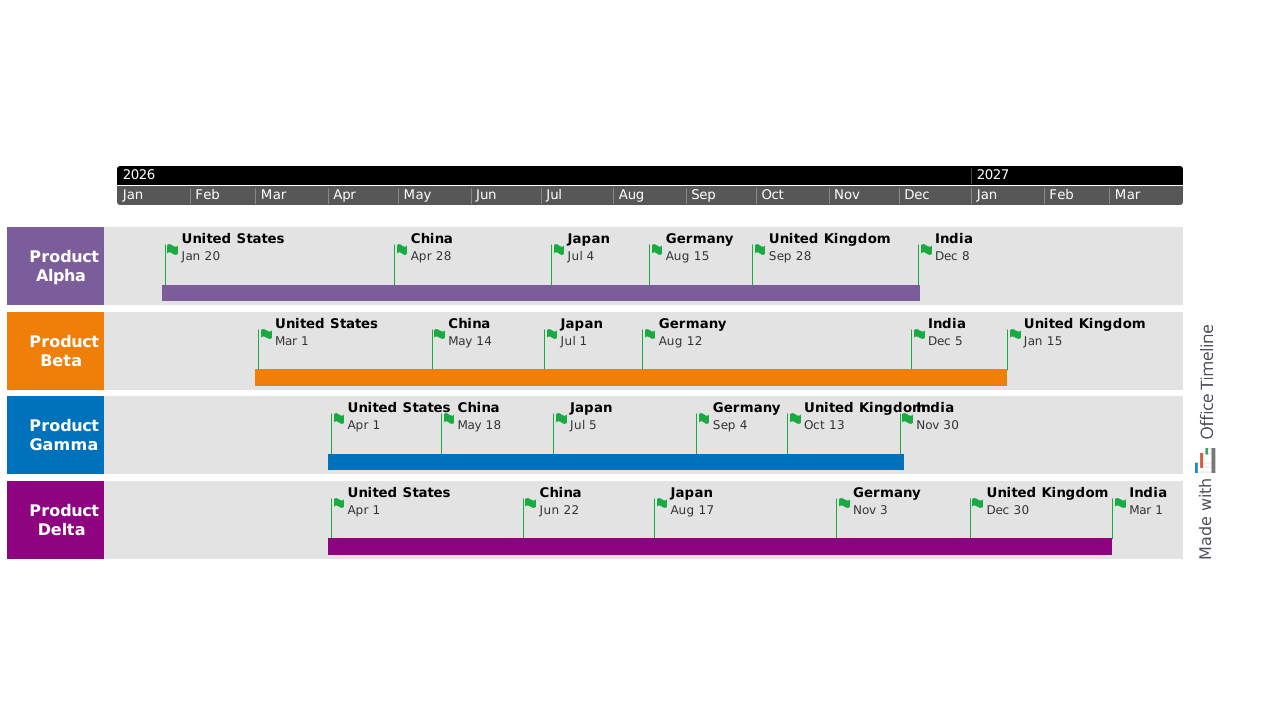
Bringing a pharmaceutical product to market is hard enough in one country. Doing it across six, eight, or ten international markets simultaneously - each with its own regulatory timeline, commercial readiness requirements, and launch date - is a project management challenge of a different order entirely.
For pharmaceutical companies, a clear, shared visual timeline is often the difference between launch success and a program that unravels under the weight of its own complexity. This international pharma launch template gives you a ready-made starting point for exactly that.
The hidden complexity behind a global pharma launch
On paper, a pharma product launch looks straightforward: get approval, launch the product. In practice, it's a multi-year, multi-market program with dozens of interdependent workstreams running in parallel and no two markets moving at the same speed.
A single product might require separate regulatory submissions in the US, EU, Japan, and beyond, each returning on a different timeline. Commercial teams in each market need to be built out and briefed. Supply chains need to be certified and ready. Medical affairs, market access, and marketing all have their own dependencies. And in most cases, you're not doing this for one product - you're doing it for several, all at once.
This is where pharma product launch programs most commonly run into trouble. It's rarely the science that causes a launch to stumble, but rather the operational complexity of keeping every team, in every market, working from the same plan. Miscommunication, misaligned timelines, and lack of visibility across functions are among the most cited reasons launches fall short of their potential.
That's why pharmaceutical timelines are one of the most important tools in a launch team's toolkit. When everyone can see the big picture, decisions get made faster, gaps get caught earlier, and the whole program moves with more confidence.
Why global pharma launch teams struggle to stay aligned
Here's a scenario most launch teams will recognize: leadership wants a status update on the international rollout, and pulling together a clear answer means digging through spreadsheets, chasing regional contacts, and stitching together information from half a dozen sources. The data exists, it's just not in a format anyone can read at a glance.
Global pharmaceutical launches span multiple products and multiple markets, often running simultaneously across different geographies on different timelines. When you're managing that kind of scope, one of the most basic but most valuable things you can do is give everyone a single view that shows which product is launching where, and when. Not a deep process document, but just a clear, shared picture of the sequencing and the schedule.
That's what a high-level timeline like this drug launch template does well. It won't replace your detailed project plans, but it gives executives, regional leads, and cross-functional stakeholders a common reference point - something they can look at together and immediately understand. Which markets are going first? How far apart are the launch dates? Where do multiple product launches overlap? Those questions are hard to answer from a spreadsheet and obvious from a well-structured timeline.
This is exactly the kind of view that our free template helps teams put together quickly, directly in PowerPoint, without design effort.
What this international pharma launch timeline helps you visualize
Multi-country launch sequencing
Global market entry is rarely simultaneous. Organizations may prioritize high-revenue markets, align with manufacturing capacity, or sequence launches based on reimbursement readiness.
This template allows teams to visualize staggered country rollouts side by side. Seeing multiple regions within a single framework supports clearer communication with leadership and enables faster adjustments when regulatory timelines shift.
Multi-product coordination
In many pharmaceutical organizations, launch teams oversee more than one asset at a time. Even if portfolio governance decisions occur elsewhere, operational coordination remains essential.
A consolidated timeline showing multiple products helps identify overlap in commercial preparation, potential strain on shared resources, and opportunities to optimize sequencing. This perspective strengthens execution discipline without conflating launch coordination with portfolio prioritization.
Executive-level visibility
Senior stakeholders require clarity into general launch strategy, not granular task tracking. A structured global launch timeline provides a concise overview of key milestones, anticipated launch dates, and regional sequencing logic.
This visibility improves reporting consistency and reduces ambiguity in cross-regional discussions. It also supports more informed decision-making when trade-offs or timeline adjustments become necessary.
Applying this template to your launch program
This template is designed to give launch teams an immediate head start on visualizing their pharma launch plan across multiple products and markets. Here's what you're looking at and how to make it your own.
Who it's for
This template is built for the people responsible for holding the big picture together: launch directors, PMO leads, regulatory project managers, marketing teams, and commercial operations teams who need to communicate program status clearly to stakeholders at every level.
How to adapt it
The structure is flexible. Swap in your own product names and target markets, adjust the number of swimlanes to match your portfolio, and compress or extend the time axis to fit your actual launch window. You can add or remove milestone flags as needed, and update colors to match your organization's conventions or branding.
To adapt this template faster, you can edit it using the Lucen Timeline PowerPoint add-in. Its drag-and-drop editor allows milestones and dates to be adjusted on the fly without manually redesigning the entire visual. Styling and restructuring are fast and simple too, reducing the cumbersome manual formatting work in PowerPoint. A 14-day free trial is available for those who want to explore how it fits into their pharma launch planning workflow.
What the template is not
This free template is a communication and alignment tool, not a process guide or regulatory checklist. It won't show all the intricacies of the new pharma product launch process or walk you through a submission strategy. What it will do is give everyone in your organization - across functions and geographies - a single, high-level view of where you're going and when.
Lessons from the most successful pharmaceutical product launches
Project and program managers who have worked across multiple global launch programs tend to notice the same patterns when they look at what separates launches that land well from those that don't. A few of the most consistent ones:
- They treat launch as a program, not a project. The most successful pharmaceutical product launches aren't managed as a single workstream with a finish line. They're treated as a program - with a dedicated launch team, clearly defined ownership across functions, and a single source-of-truth plan that everyone is working from. The difference sounds subtle, but it changes how decisions get made and how quickly problems surface. Adopting a pharma launch excellence framework is essential for high-performance launches.
- Market sequencing is deliberate, not default. It's easy to default to "US first" because that's how it's often been done, but the strongest drug launch strategy teams make sequencing decisions based on regulatory readiness, market access timelines, and strategic priority. Which market gives you the most meaningful early data? Which approval is most likely to influence others? These are planning questions worth answering before the timeline gets set.
- Internal alignment comes before external launch. The teams that execute best tend to over-invest in getting their own house in order before the market-facing work begins. That means shared plans, clear escalation paths, and regular cross-functional check-ins - not just within a region, but globally. A launch that's well-coordinated internally is far more likely to land well externally.
- Product differentiation and patient population targeting are prioritized. Successful launches focus on clear product differentiation, understanding the specific patient population, and tailoring strategies for competitive markets and each therapeutic area. This ensures the product stands out, meets regulatory requirements, and addresses payer expectations.
- Visual tools reduce the cost of communication. This one is practical but often underestimated. When your plan is visual, shared, and easy to read, you spend less time in alignment meetings and more time making progress. The global launch teams that communicate clearly tend to move faster (and catch issues earlier) than those working from dense documents that only a few people fully understand.
Frequently asked questions
A successful pharma product launch follows a structured program typically broken into pre-launch, launch, and post-launch phases, spanning anywhere from 18 months to several years depending on the scope. From a project management standpoint, the foundation is a cross-functional plan that aligns regulatory, medical, commercial, and supply chain workstreams around a shared set of milestones and market-specific launch dates. Clear ownership, regular status visibility, and a single source-of-truth timeline are what helps drive launch success as complexity scales.
International pharma launches require sequencing markets based on regulatory readiness, reimbursement timelines, and strategic priority. Many pharma companies use a lead-market and follow-market model, identifying which markets to prioritize for early launch and which will follow once approvals and commercial infrastructure are in place. Managing this effectively means maintaining a master timeline that shows all markets on a single view, so the dependencies between tracks are visible to everyone involved.
Bringing a drug from discovery and clinical development to market launch typically takes 8 to 12 years or more. This includes preclinical research, clinical trials across multiple phases, regulatory submission, and review.
For multi-market international programs, the full launch window can extend depending on the number of markets, the complexity of regulatory environments in each, and the sequencing strategy the team has chosen. Planning for the full duration (not just the first launch date) is essential for resource allocation and cross-functional coordination.
A drug go-to-market strategy covers market segmentation, pricing and reimbursement positioning, key opinion leader engagement, and commercial readiness, and these are all mapped against the regulatory approval timeline for each market. From a project management perspective, the critical element is aligning every workstream to a specific launch date per market, with clear accountability at each milestone. The sequencing of markets, the pacing of the commercial build-out, and the timing of medical and scientific communication all need to be visible in a single coordinated plan.
While many countries allow advertising of over-the-counter medicines, the USA and New Zealand are the only two countries in the world that permit direct-to-consumer (DTC) advertising of prescription drugs that names both the product and its indication. This has a meaningful impact on launch strategy for those markets, where consumer-facing campaigns can be part of the commercial launch plan in a way that isn't possible in most other countries.
Canada does allow pharmaceutical advertising, but with important restrictions. While advertising of over-the-counter medicines is permitted, DTC advertising of prescription drugs is limited.
Canadian regulations allow certain types of consumer advertising, such as reminder ads (which name the drug but not its use) and help-seeking ads (which describe a condition but do not name a specific drug). Advertisements that promote both a prescription drug and its indication directly to the public are not permitted. These restrictions influence how the commercial launch strategy is structured for the Canadian market.
The United States has the world's largest pharmaceutical market by revenue, which is why most global launch programs treat it as the primary lead market. It is followed by China, Japan, Germany, and the United Kingdom, all of which appear frequently in international launch sequencing plans.
From a launch planning perspective, the pipeline areas generating the most activity right now include GLP-1 receptor agonist therapies, RNA-based medicines, precision oncology treatments, cell and gene therapies, and AI-assisted drug development. Each of these categories brings its own launch complexity, particularly around market access, reimbursement negotiations, and the pace at which regulatory bodies in different countries are equipped to evaluate them. For pharma companies and launch teams, that means the planning horizon is getting longer and the cross-functional coordination requirements are getting more demanding, not less.

Your download should start now. If it doesn’t start click here and check your inbox for tips to get started.