


Kanban and Scrum are two of the most widely used Agile project management frameworks. Both help teams organize work, improve collaboration, and deliver projects more efficiently, but they approach workflow management in different ways.
While Scrum focuses on structured sprints, defined roles, and iterative planning, Kanban emphasizes continuous delivery, flexibility, and visual task management. Choosing the right approach depends on your team structure, project type, and preferred way of working.
Originally popular among software and IT teams, both methodologies are now widely adopted across industries such as marketing, healthcare, consulting, and product development.
In this guide, we’ll explore the key differences between Kanban and Scrum, how each framework manages workflows, and how to determine which method best suits your team’s needs.
What is Agile project management?
Agile project management is an approach to project management that, as we already know, is a way, supported by knowledge, skills, methodologies, and tools (such as project management software) to develop new products and services.
Project management, and consequently Agile project management and Kanban and Scrum approach, follows 3 phases: initiation, planning, and execution.
When developing a project plan, these 3 phases must be followed respecting the budget and time of release.
Agile methodology derives from project management and, indeed, it also shares the aim to achieve a goal in different stages and steps.
With project management, we have a big launch or product update, while, with agile management, the goal is split into small chunks (all of them with a specific prioritization) and it has the goal to continuously deliver product updates and new features respecting the planned deliverables.
Agile methodology answers to the nowadays market needs that want competitors able to constantly develop new product/service features or product iterations putting clients ’ feedback and requests first.
Agile is based on 4 principles:
- Individuals and clients ‘necessities come before tools;
- Answering people’s needs instead of following a planned and strict workflow;
- Customer’s listening putting collaboration first;
- Useful and functioning software development over comprehensive documentation.
Agile project management offers a way to be more competitive, fast, and malleable and this is the reason why software houses tend to adopt it instead of the more traditional and “structured” project management one.
If you evaluated that agile methodology is the approach that might help you the most to better work on your project, then you just need to make up your mind and adopt Kanban or Scrum approach.
Both Kanban and Scrum are efficient ways to manage a project and its continuous improvement but, while the Kanban approach has a more fluid and malleable approach, Scrum is more rigid but very fast since it is structured in a brief but intense flow of work (sprints).
To better evaluate which approach suits you better let’s see what Kanban and Scrum work
What is Kanban?
Kanban is a flexible Agile methodology designed to improve workflow visibility and help teams manage work more efficiently. Instead of organizing work into fixed sprints, Kanban focuses on continuous delivery and steady progress through clearly defined stages.
The term “Kanban” comes from the Japanese expression for “visual signal.” The methodology uses visual boards and task cards to help teams track completed work, ongoing tasks, and upcoming priorities in a simple and transparent way.
Originally developed in the 1940s by Toyota engineer Taiichi Ohno, Kanban was created to improve manufacturing efficiency and monitor production workflows more effectively. Today, it is widely used not only in software development, but also in marketing, operations, product management, and many other industries.
One of Kanban’s biggest advantages is its ability to help teams identify bottlenecks, balance workloads, and improve overall employee productivity through better workflow organization and collaboration.
Kanban teams often organize work around user stories, which describe features and tasks from the end user’s perspective. This approach helps development teams better understand customer needs and build solutions that deliver real value.
Because Agile methodologies prioritize people and user needs over rigid processes, user stories are usually written in clear, non-technical language that gives teams practical context and keeps development focused on solving real problems.
Once teams fully understand the user story, they can more effectively design and deliver features that meet customer expectations. This user-centered approach is one of the core principles behind Agile project management and plays an important role in building successful products and services.
How Kanban boards work
Kanban was thought to visualize work and, for this reason, it relies on boards, cards, columns, work in progress (WIP), commitment points, and delivery points.
All of them help the team to acknowledge and visualize the right amount of work that needs to be done and the current work in progress.
- Visual signals are visual cards, and they are normally used by team members to write on them work items and tasks, usually one per card. This helps the development team to keep an eye on what they are working on.
- Columns represent a specific activity that together composes a “workflow”. So cards compose the workflow and are piled one onto another (with a focus on prioritization) until the project is completed.
- With Work in progress (WIP), Kanban acknowledges that there has to be a maximum of 3 cards piled in one column.
Work in progress aims to suggest to the team that it cannot work on more than 3 tasks otherwise employees risk losing focus on the prioritized activities. - Commitment point: Kanban teams have a product backlog for their board and it is here that both teammates and users write down the ideas for the projects. It is a shared and collaborative way to develop great products!
- The delivery point is the final one in the workflow. What the team aims to do is to reduce the so-called lead time: the time between the beginning of the project and its end represented, indeed, by the delivery point.
So it is here that the team makes its evaluation and decides if the project has been handled well or not.
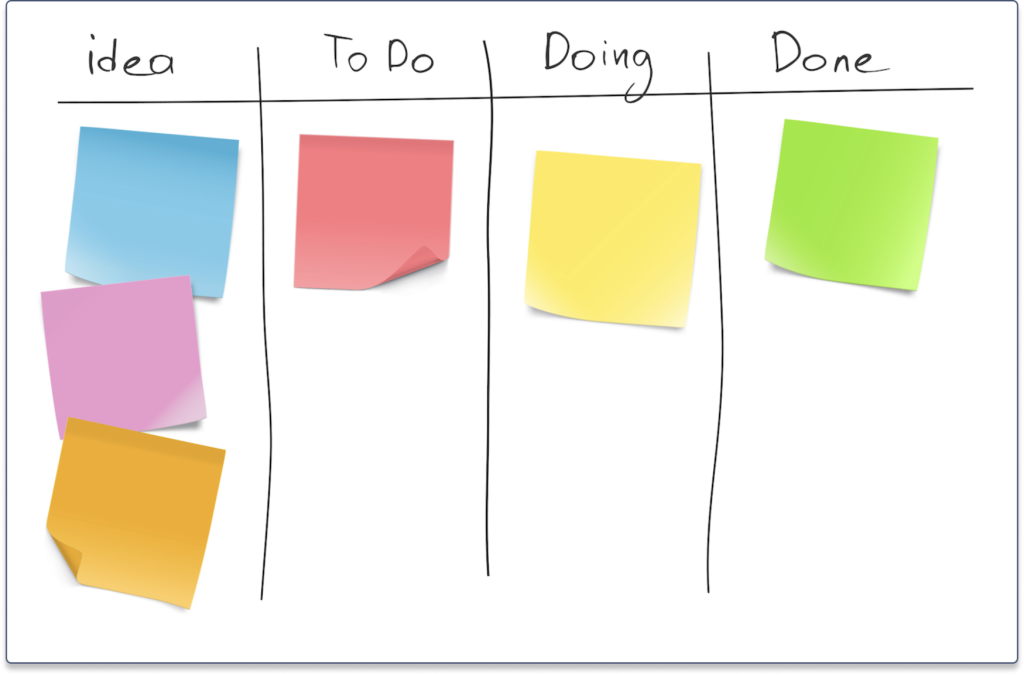
The Kanban method can be easily applied to each project or project-based business but is a great approach for all those companies that are working on many projects for different clients with different deadlines and priorities. Indeed, more cards can be added and put before others to pursue a new order of prioritization in the workflow.
Also keeping an eye on a visual workflow help the user to immediately understand what is finished, what needs more effort, and what needs some changes.
To see if everything is going as supposed to, it is important to monitor lead time and cycle time.
With Lucen Track you can track the time spent on each project, and its phases, in real-time, keep an eye on your team members’ work, and set email reminders.
Thanks to detailed reports, it is possible to receive insightful knowledge about how you and your team have managed the project life cycle and if you were able to stay on time and within budget.
Combining time-tracking software with a project management one is the perfect way to improve a company’s efficiency and productivity and make future project releases easy and stress-free.
What is Scrum?
Scrum is the most common and used agile project management approach in the whole world, and it was designed for all of those companies that are in a fluid market exposed to changes.
This agile method is stricter than the Kanban approach, but it implies a shorter amount of time, called sprint, that has the main goal to release a feature, product iterations, or a new service.
Scrum methodology is usually adopted by software houses that structure their work on projects, tasks, and activities; all of them at the same time.
Companies that focus a specific amount of time on getting that activity, and tasks done thanks to a great focus of all of the company members, find the scrum method perfect for them.
Scrums usually last 2 weeks and they, indeed, are broken up into sprints that have the goal to focus on single, split tasks.
The team splits complex projects into smaller tasks and activities and each of them is prioritized and put into the calendar with its related deadline.
The Scrum workflow
To better organize the amount of work and its work in progress, the sprints are precisely organized in steps:
- Sprint planning: The goal of this step is to evaluate and decide what has to be done in the sprint and how it should be done (how many employees will be working on it, for how long, etc.). At the beginning of each sprint, in the sprint planning, activities and their deadlines, have to be written down in the sprint backlog.
- Daily Scrum: At the beginning of each sprint day, the team members meet up and decide what are the daily tasks and what they should do, how they have to do it, and if there are common tasks that need reciprocal work. All of these always keep an eye on the sprint backlog.
What matters here is to all be aligned knowing what has been done the day before, what should be done during the day, and if there is a task that needs a collaborative approach. - Sprint review: In this sprint step the team members should show each other what has been done (acknowledging the priorities written down in the backlog) and talk about what needs to be done in the next future.
- Sprint retrospective: The sprint is completed so it is now time to discuss what has been handled well and what, instead, needs some improvement.
This step is extremely important since its goal is to find process improvements that might be inspirational for the next sprint.
Key Scrum roles
Scrum is different from Kanban also for what regards the team, its size, and the team members’ roles.
If in the Kanban approach, the development team members work on different tasks of the same project, in Scrum it is possible to do it only when a single task and the role of each team member is strictly related to the single task of the sprint.
The Scrum team usually includes three important roles:
- Scrum Master: The Scrum Master leads the team and ensures that Agile principles and Scrum practices are properly followed. This role is responsible for helping the team stay on schedule, work efficiently, and deliver product updates or features on time. The Scrum Master also supports, motivates, and guides team members, encouraging continuous improvement and better collaboration. In addition, they help identify and resolve blockers and may stop the sprint if the project is moving in the wrong direction.
- Product Owner (PO): The Product Owner represents the voice of the customer and stakeholders within the team. Their role is essential because they translate user needs and feedback into actionable requirements and help define the direction of product development. The Product Owner manages and prioritizes the backlog daily, ensuring the team focuses first on delivering the features that provide the greatest value to users.
- Team: The team consists of the employees and specialists who work directly on the project. They transform user stories into functional product features and collaborate throughout the sprint to plan, develop, test, and deliver the final result.
Kanban vs. Scrum: Which should you choose?
Kanban and Scrum methods are agile project management methodologies that help companies to work in an always-changing and competitive environment where users demand useful, easy-to-use, and always new devices.
While the Kanban method is a fluid and continuous approach that makes time and project tasks visualizable, Scrum is a stricter approach that focuses all the team energies on a single sprint.
Both Kanban and Scrum aim to help companies to make better services or products but, while Kanban aims to limit work in progress in favor of maximizing efficiency, Scrum aims to focus on the incrementation of work splitting it into sprints.
Kanban wants to reduce the amount of time that a project takes using Kanban boards while continually improving the workflow.
Scrum adopts specific roles and rules to follow daily to reach the goal in the amount of time decided at first.
What is different is the time approach: in Kanban, the time has to be followed and controlled during the flow of work while, in Scrum, it is already decided and not put into question.

But, both of them consider time as the main way to measure if a project has been handled well.
It is indeed important to keep an eye on time integrating your project management tool into Lucen Track!
Lucen Track is a time tracking software that helps you and your team to track time in real-time, both online and offline, and, thanks to insightful reports, it helps you get the data you need to evaluate if the agile project management you adopted was the right one!
Sign up now and receive your 14-day free trial!

Subscribe to our blog
Get all the tips, tricks and inspiration you need to create professional looking timelines, straight to your inbox.